Polyester mesh fabric has grown from a functional specialty material into one of the most widely used textiles in modern apparel and technical production. Its open-knit construction delivers breathability, lightweight comfort, and visual texture in a way that few other fabrics can match.
For product developers, sourcing teams, and brand owners, understanding this fabric family has become essential to making sound material choices. This guide explores the core structures of polyester mesh, the performance benefits that set it apart, the applications that depend on it, and the practical criteria for selecting the right mesh for a specific end use.
Polyester mesh belongs to the knitted fabric family, distinguished by its open, repeating perforations. Where woven fabrics are formed by interlacing warp and weft yarns at right angles, mesh knits are produced on circular knitting machines as a continuous loop structure. This construction gives the fabric natural elasticity and recovery, while the engineered openings let air and moisture vapour travel freely through the material.
The choice of 100% polyester as the base fibre is not incidental. Polyester is quick-drying, wrinkle-resistant, and dimensionally stable, so it stands up to repeated washing and demanding use. When combined with an open knit structure, these qualities are amplified: moisture moves away from the skin quickly, evaporation happens faster, and the wearer stays cooler for longer.
Polyester mesh, however, is not one fabric but a family of fabrics. Variations in stitch geometry, filament thickness, and finishing treatment produce meshes with very different hand-feel, drape, and performance. A deeper look at how these variations affect finished products—explored in this guide to polyester mesh types, features, and applications—helps sourcing teams avoid costly selection errors.
Three knit structures account for the majority of polyester mesh used in apparel and technical products. Each offers a unique trade-off between breathability, surface character, and structural strength.
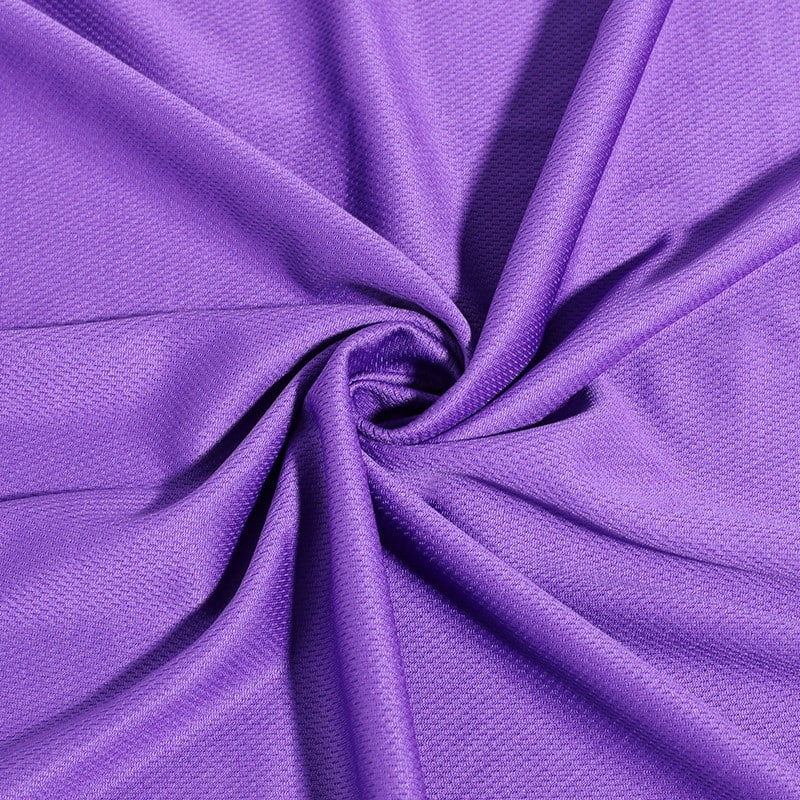
Bird's eye mesh features small, evenly distributed openings formed in a double-knit construction. The perforations are subtle, so the fabric provides good opacity while still delivering ventilation. Weights typically range from 145 gsm to 150 gsm, and finishes can be adapted to meet specific requirements—including antibacterial treatment, anti-pilling performance, or quick-dry functionality for activewear and home textile applications.
 145GSM Polyester Knitted Bird Eye Fabric for ActivewearThis lightweight bird's eye mesh balances coverage and airflow, making it a practical choice for training tops, shorts linings, and base layers. Its subtle perforations and quick-dry options suit performance apparel.View Product →
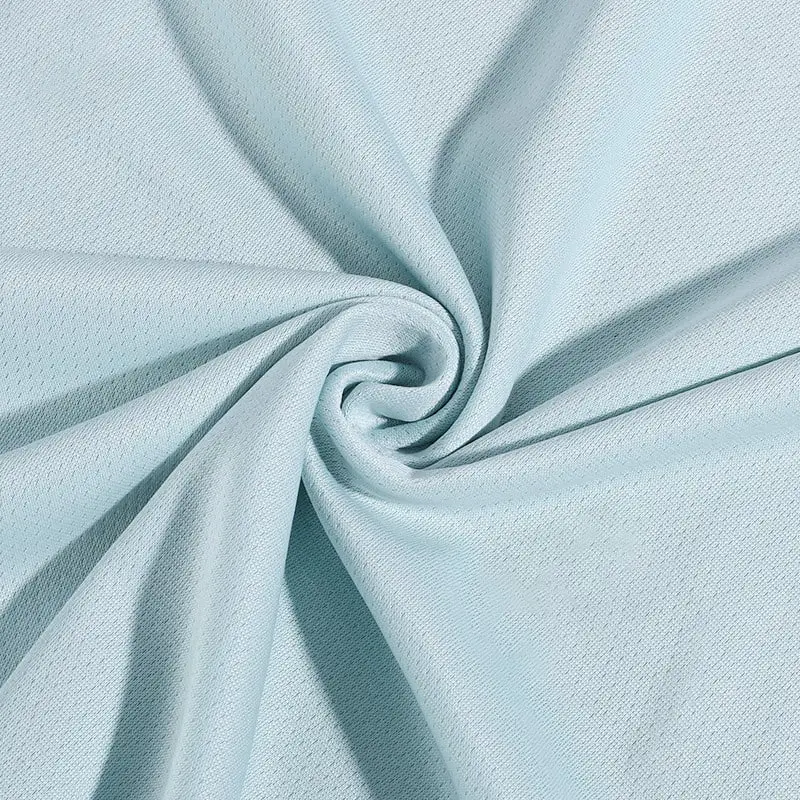
Micro-dot mesh takes a finer approach, using smaller, closely spaced perforations that read as a subtle texture rather than an obvious open mesh. From a distance the fabric looks almost solid; close up, it offers discreet ventilation. This character makes it a preferred choice for custom jerseys, outdoor apparel layers, and shoe uppers, where designers want technical performance without a heavy mesh aesthetic. The structure also accepts sublimation printing beautifully, enabling vivid, long-lasting team graphics.
 145g/m² Polyester Micro Dot Knit for SportswearWith fine micro-dot perforations, this fabric offers discreet ventilation and a smooth look. Ideal for custom jerseys and outdoor layers, it also takes sublimation printing for vivid team graphics.View Product →
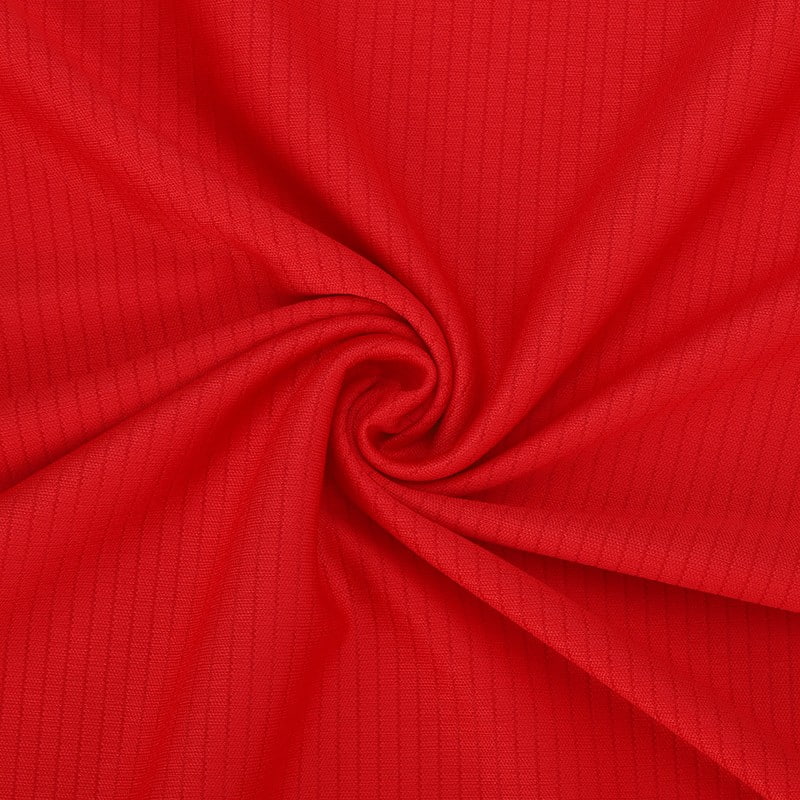
Grid mesh presents its structure openly. Pronounced geometric openings—square, hexagonal, or diamond-shaped—form a regular pattern across the fabric surface. These constructions are typically more substantial, with weights spanning 115 gsm to 165 gsm and widths reaching 200 cm. The robust, abrasion-resistant nature of grid mesh makes it ideal for outdoor jackets, sportswear linings, and shoe upper reinforcement. Ventilated grid-mesh versions add extra airflow for high-intensity activities.
 Ventilated 100% Polyester Grid Knit for Outdoor JacketsThis open grid mesh provides high breathability and moisture resistance for outdoor jackets. Its robust, abrasion-resistant structure works well in underarm panels, linings, and other ventilation zones.View Product →
Polyester mesh earns its place in product development because it delivers repeatable, measurable benefits. These are the properties that matter most in real-world garment construction:
These attributes are not accidental; they are engineered through fibre selection, stitch geometry, and finishing chemistry. For buyers, that means a carefully written specification translates directly into dependable field performance.
Polyester mesh's technical attributes reveal their true value when matched with the right end use. The material now appears across a surprisingly broad range of product categories.
Ventilation panels in training tops, shorts, sports bras, and base layers help regulate body temperature where athletes need it most. Custom team jerseys are a growing application for micro-dot mesh, thanks to its smooth printing surface and durable colour retention.
Outdoor jackets, backpacks, and technical garments rely on grid mesh for its strength and airflow. Mesh lining fabrics inside shells prevent the stifling sensation that builds during strenuous climbs, while adding minimal weight or bulk.
Running shoes, trail trainers, and casual sneakers increasingly use polyester mesh uppers, which wrap the foot comfortably while allowing heat and moisture to escape. The fabric's stretch behaviour can be tuned during knitting, enabling it to conform to the shoe last without losing structural support.
Quick-drying bird's eye mesh is used in home textile linings to reduce moisture retention in cushion covers and mattress protection layers. Safety-oriented mesh fabrics are also specified with adjusted widths and constructions for protective equipment programmes.
Choosing the right mesh involves more than responding to the visual appeal of a swatch. The following parameters provide a structured way to compare candidates.
| Parameter | What to Consider | Typical Range |
|---|---|---|
| Fabric Weight | Lighter fabrics suit linings and base layers; heavier types provide structural rigidity | 115–170 gsm |
| Fabric Width | Wider rolls improve cutting yield; confirm with your marker layout | 140–200 cm |
| Knit Structure | Bird's eye for subtle breathability; micro-dot for fine texture; grid for abrasion resistance | Depends on use |
| Functional Finish | Antibacterial, anti-pilling, quick-dry, and sublimation-ready options adapt the base fabric | Customisable |
| Stretch Behaviour | Four-way stretch suits fitted garments; stable versions work better in structured panels | Varies |
Once a specification is clear, the next question is whether the manufacturer can deliver consistent quality at scale. Production capacity, quality control systems, and responsiveness are the true differentiators among textile suppliers.
Cixi Derun Industrial, a vertical textile manufacturer based in Cixi, Zhejiang Province, operates a 36,000-square-metre facility with more than 200 precision circular knitting machines and 18 high-speed elastic yarn machines. With an annual output of approximately 15,000 tonnes and additional production capacity reaching up to 20,000 tonnes, the company supports programmes ranging from mid-sized brands to large-volume procurement. ISO- and CE-aligned quality management procedures provide added confidence for international buyers, and exports reach more than 20 countries across North America, South America, Europe, and Asia. Explore the full range of polyester mesh fabrics that this production capability supports.
Polyester mesh is far more than a utilitarian knit. It is an engineered material family with distinct structures, predictable performance, and a wider range of end uses than most teams initially assume. The key to success lies in careful specification: matching weight, structure, width, and finish to the demands of the final product.
The fabric that performs best on the production line is the one that was selected with discipline, tested against real conditions, and supplied by a partner who understands the engineering behind every stitch.
With the right mesh and the right manufacturing partner, polyester mesh becomes a genuine strategic advantage. Comfort, durability, ventilation, and visual consistency are all achievable when the material choice is grounded in technical understanding.
May 27, 2026 – Global — The polyester mesh fabric industry is witnessing robust global growth in 2026, fueled by surging demand across sportswear, industrial m...
READ MOREQuick Answer: What Is Polyester Mesh Fabric? Polyester mesh fabric is a lightweight, breathable, and durable woven or knitted textile made from polyester fiber...
READ MOREMill Notes - Performance Knits Polyester Sports Fabric A working guide to knit structures, weights and finishes, written from the knitting floor rather than th...
READ MOREA Derun Editorial — Fabric Engineering 100% Polyester Fabric: A Study in Structure It shapes a running shoe’s upper, lines a structured jacket, and lifts a go...
READ MORE Ready To Customise
100% Polyester Knitted Bird Eye Fabric: A Technical Guide to Breathable Knits
100% Polyester Fabric Explained: A Manufacturer's Guide to Performance Knits

Telephone: +86-18268669232

Email: [email protected]

Company Address
Linxi Village, Xiaolin Town, Cixi City

 English
 عربى
 中文