Technical Fabric Series — Knitted Mesh
The Quiet Intelligence of Bird Eye Knit
A practical field guide to 100% polyester knitted bird eye fabric — the open-structure knit that moves with the body, breathes with ease, and dries before you notice.
Some fabrics are quiet. They don't announce themselves with heavy textures or loud branding. Instead, they solve problems: trapped heat, lingering moisture, stiffness where freedom of movement matters. 100% polyester knitted bird eye fabric belongs to this category. Its small, repeating diamond-shaped openings are instantly recognizable, yet the real value lies beneath the surface — in how the structure manages air, water, and wear.
Our mill in Cixi has been refining bird eye knits for nearly two decades. We supply sportswear brands, footwear manufacturers, home textile producers, and specialized safety manufacturers across more than twenty countries. This guide reflects what we have learned on the factory floor — and what we tell every designer and purchaser who asks where to begin.
01
The name comes from the fabric's surface. A field of small, evenly spaced oval or diamond-shaped openings resembles the pattern of a bird's eye. This geometry is not decorative. It is the result of a precise knitting sequence that alternates and tucks loops to create openings while surrounding stitches lock the structure together.
Unlike woven mesh, which must be cut and sewn into shape, a bird eye knit is produced directly from yarn on a circular knitting machine. That distinction matters: fewer seams, less waste, and a fabric that already behaves like a finished component.
These traits make bird eye knit one of the most versatile structures in the polyester knitting family.
02
Bird eye geometry can be knitted from many fibers, but polyester allows the structure to perform at its best.
Polyester brings qualities that modern textiles depend on: dimensional stability that keeps the eyelets open wash after wash, rapid moisture transport, quick drying, strong color retention, and easy care with minimal shrinkage. Recycled and functional polyester variants add even more flexibility without compromising durability.
The knit structure adds its own strengths. It stretches and recovers with the body, conforms smoothly around curved surfaces like shoulders and shoe uppers, and bounces back from compression without permanent creasing. A well-engineered bird eye knit is essentially a miniature ventilation system built into the garment.
03
Every buyer asks the same question: what will this fabric actually do? The table below summarizes the performance profile our customers rely on.
| Performance attribute | What it means | Where it matters |
|---|---|---|
| Breathability | Open eyelets allow air to move through the fabric | Sportswear, linings |
| Moisture wicking | Polyester fibers move sweat away from the skin | Activewear, training tops |
| Quick drying | Open structure and low moisture regain speed up drying | Travel apparel, team wear |
| Lightweight | Low weight keeps garments comfortable | Layering, footwear uppers |
| Abrasion resistance | Durable loops withstand friction and heavy use | Workwear, overdyed garments |
| Easy care | Minimal shrinkage, no ironing required | Uniforms, everyday apparel |
If your product needs to breathe, dry quickly, and hold its shape, bird eye knit belongs on your shortlist.
04
Because the structure can be tuned — opening size, loop density, yarn count, finished weight — bird eye knit serves a surprisingly wide range of products.
Training tops, team jerseys, and running layers benefit directly from the fabric's ventilation and stretch. The eyelets release heat the moment it builds, while the polyester base keeps the garment light and quick to dry. Printed versions make it easy to add team colors and logos without stiff, heavy prints.
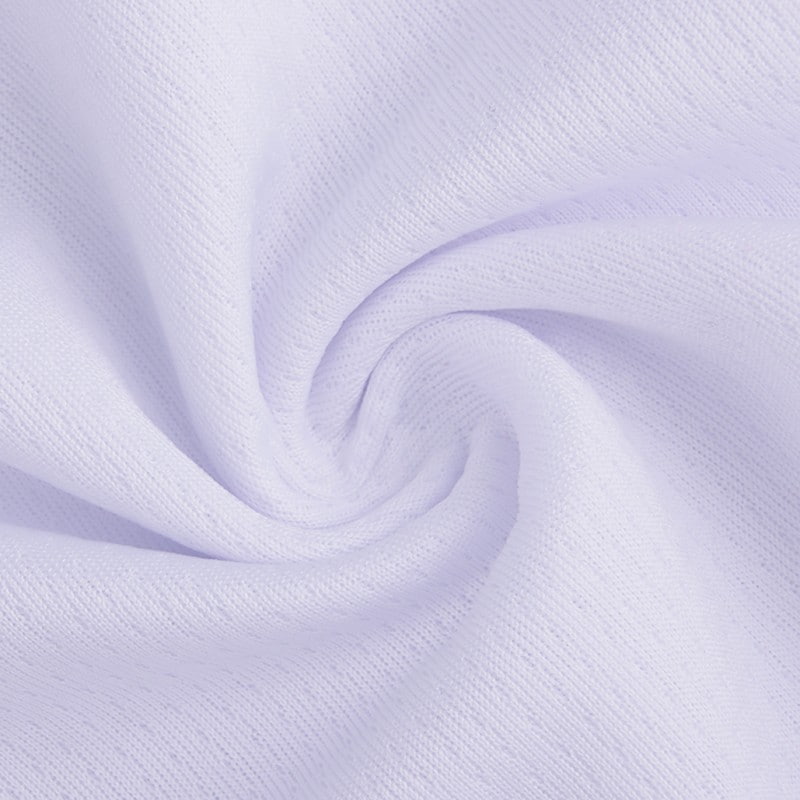
 Breathable 150g Polyester Bird Eye Knit for SportswearThis lightweight polyester bird eye fabric balances ventilation and durability, making it ideal for training tops, jerseys, and running layers that need quick-drying comfort.View Product →
Shoe uppers and linings need materials that conform to curved lasts, resist lace abrasion, and stay breathable over long hours of wear. Fine bird eye constructions provide that balance, and the open structure trims weight from every pair.
In home textiles, bird eye knit appears in linings and breathable layers wherever air movement improves comfort — cushion interiors, mattress protection layers, and quick-drying household textiles that suit humid climates.
For safety applications, a wider 160 cm bird eye fabric offers the coverage, consistency, and stability needed for protective garments and industrial products. The open structure keeps the wearer cooler without sacrificing the strength of the polyester base.
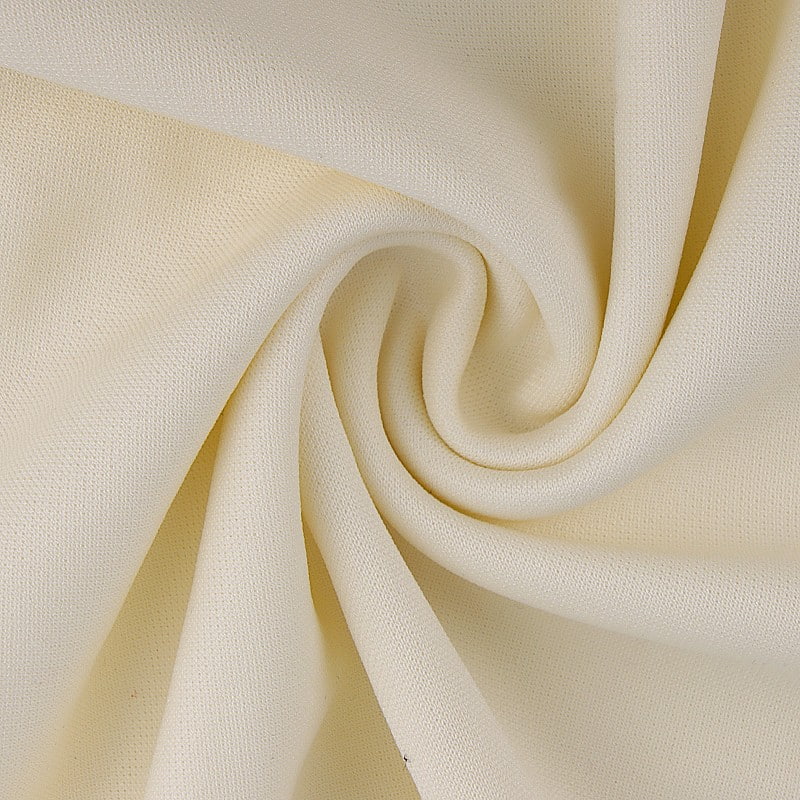
 160cm Bird Eye Mesh for Safety Vests and High-Visibility WearEngineered for safety apparel, this breathable 120g polyester mesh provides consistent coverage and lightweight comfort, supporting efficient cutting for industrial garment production.View Product →
Digital sublimation and polyester are a natural pair. The dye bonds with the fiber at a molecular level, producing colors that stay bright through dozens of washes. Custom jerseys, event uniforms, and school sportswear all rely on this combination.
05
A base bird eye fabric is already a capable textile. The real flexibility appears when functional finishes are added. Over the years, we have developed versions that go beyond the standard construction:
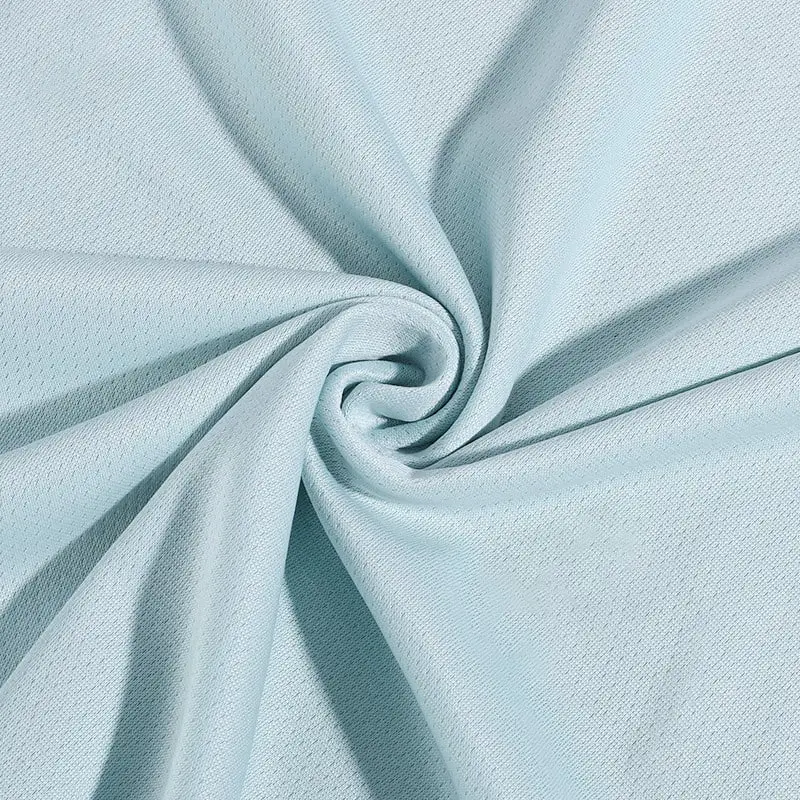
 Antibacterial Bird Eye Fabric with Soft Handfeel for Custom FinishesThis 145g polyester knit pairs antibacterial function with a soft touch, offering a base for tailored finishes—softer drapes or firmer panels—for specific garment needs.View Product →
These are not off-the-shelf options. Our development team works with different molds, yarn counts, and finish combinations to adjust the fabric to a specific application — whether that means a softer hand for a close-fitting garment or a firmer hold for a structured panel.
06
Choosing a bird eye fabric is rarely about finding "the best one". It is about finding the right match for your product, your production line, and your end customer.
"Bring us the problem, not just the specification. The right bird eye fabric is the one that solves how your garment is used, washed, and worn — and that conversation usually starts with a single sample meter."
If you are comparing several polyester options, our guide to choosing the right polyester fabric for your project walks through the full decision framework in more depth.
07
A few practical reminders we share with every new partner.
08
Bird eye fabric is not a commodity when it is made with attention. At our 36,000-square-meter facility in Cixi, more than 200 high-precision circular knitting machines and 18 high-speed elastic yarn machines run continuously, producing around 15,000 tons of knitted fabric each year. The scale matters, but what matters more is consistency — the same opening, the same weight, the same hand feel from the first meter to the last.
Quality control follows ISO and CE-based procedures at every stage, from yarn inspection to final inspection before shipment. With our own trading and manufacturing subsidiaries under one structure, communication stays direct — one team, one set of expectations, one point of contact.
You can read more about our journey as a textile manufacturer, or simply start a conversation with the team that knows bird eye knit from the inside out.
The quiet intelligence of bird eye knit is easy to miss in a swatch book. But once you see it perform — on a training field, inside a shoe, under a warm climate — it becomes difficult to design without it.
Structure, weight, finish: the right combination turns a simple polyester knit into a precise tool for comfort. Whether you are developing a new sportswear line, refreshing a home textile collection, or solving a ventilation problem in a specialized product, bird eye fabric is worth a closer look. And when you are ready, we are ready — with the machinery, the experience, and the patience to get the details right.
— The Derun Textile Team, Cixi
A Derun Editorial — Fabric Engineering 100% Polyester Fabric: A Study in Structure It shapes a running shoe’s upper, lines a structured jacket, and lifts a go...
READ MOREPolyester mesh fabric has grown from a functional specialty material into one of the most widely used textiles in modern apparel and technical production. Its...
READ MOREMill Notes - Performance Knits Polyester Sports Fabric A working guide to knit structures, weights and finishes, written from the knitting floor rather than th...
READ MOREMay 27, 2026 – Global — The polyester mesh fabric industry is witnessing robust global growth in 2026, fueled by surging demand across sportswear, industrial m...
READ MORE Ready To Customise
100% Polyester Knitted Bird Eye Fabric: A Technical Guide to Breathable Knits
100% Polyester Fabric Explained: A Manufacturer's Guide to Performance Knits

Telephone: +86-18268669232

Email: [email protected]

Company Address
Linxi Village, Xiaolin Town, Cixi City

 English
 عربى
 中文