Mill Notes - Performance Knits
Polyester Sports Fabric
A working guide to knit structures, weights and finishes, written from the knitting floor rather than the showroom.
Every technical garment begins with a quiet decision about cloth. Before the pattern is graded and the colour is approved, someone has to answer one question: which knit will carry this garment through a training session, a wash cycle and a full season of use? We have been knitting polyester in Cixi, on the southern shore of Hangzhou Bay, for over a decade, and that question still shapes our working day. Our lines run more than two hundred circular knitting machines, and the fabric leaving them ends up in running tops, football jerseys, cycling shorts, outdoor jackets, shoe uppers and linings.
What follows is the guide we wish more buyers had read before the first sample request arrived.
Polyester is a synthetic filament yarn, usually polyethylene terephthalate, and it behaves in ways that natural fibres cannot match in an active setting. It does not hold water the way cotton does. Moisture travels along the filament instead of soaking into the fibre, so sweat spreads across the surface of the cloth and evaporates quickly. A polyester knit can feel dry again within minutes, while a comparable cotton jersey stays damp far longer.
That single property explains a great deal, but not everything. Polyester also holds its shape, resists stretching at cuffs and necklines, dyes evenly, accepts sublimation printing, and behaves consistently from one production run to the next.
Designers rarely ask for "polyester". They ask for a fabric that dries in eleven minutes, survives a hundred washes, or prints a sponsor logo without blurring. Polyester is simply the material that gets them there.
Almost every polyester sports fabric we produce belongs to one of four structures. They overlap in appearance, and buyers often use the names loosely, so it helps to separate them by how they are knitted and what they are asked to do.
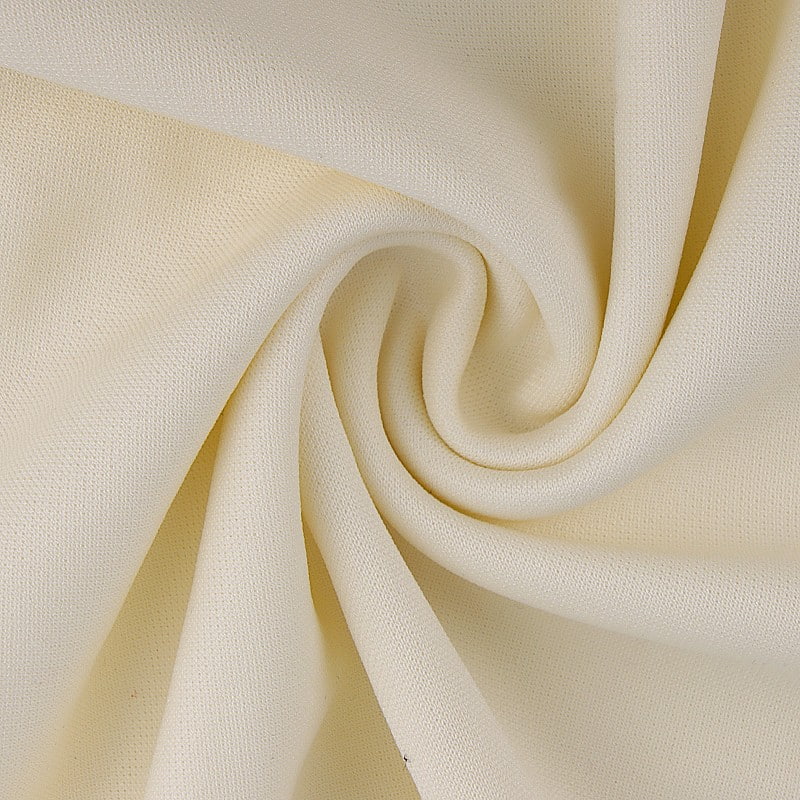
Bird's eye is our most versatile mesh family. A fine raised pattern sits on the face of the cloth, giving it a soft hand feel without losing the open structure that lets air through. Standard weights sit around 145 to 150 grams per square metre, and the family extends into fine bird's eye, anti-pilling and antibacterial versions, solid colour and sublimation-ready variants, and a 160 centimetre width produced for safety applications. The same open structure reappears as home textile lining, which says something about how flexible a mesh knit can be.
 Lightweight Breathable Polyester Bird Eye Knit for SportswearA 100% polyester knitted bird eye fabric at 140 gsm and 160 cm width, offering lightweight breathability for sportswear and active clothing.View Product →
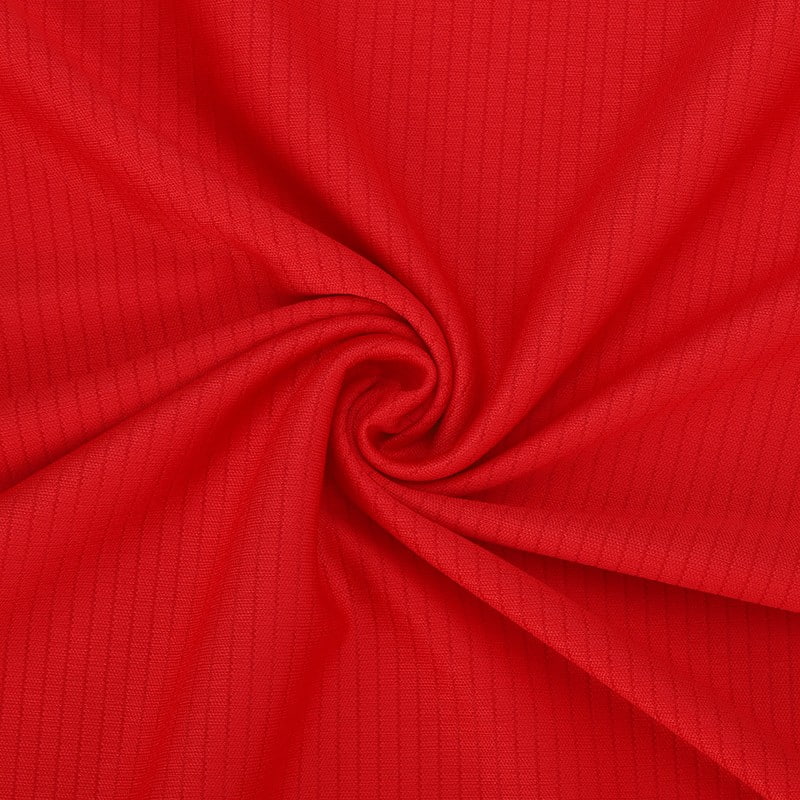
Where bird's eye relies on subtle texture, grid knits make structure visible. A square mesh pattern lifts the surface, and hexagonal honeycomb versions open it further. We knit these between 115 and 165 grams in widths of 150, 160 and 200 centimetres. The range covers ventilated versions for outdoor jackets, abrasion-resistant versions for hard-wearing training wear, stable versions for shoe uppers, and mesh-like versions for sportswear linings. Because the pattern is regular, the fabric also reads cleanly when it is cut into panels.
 Quick-Dry Polyester Grid Knit Fabric for SportswearA 145 g/m² polyester grid knit at 160 cm wide, using shaped yarns for quick drying in training tops, compression wear, and mesh sportswear.View Product →
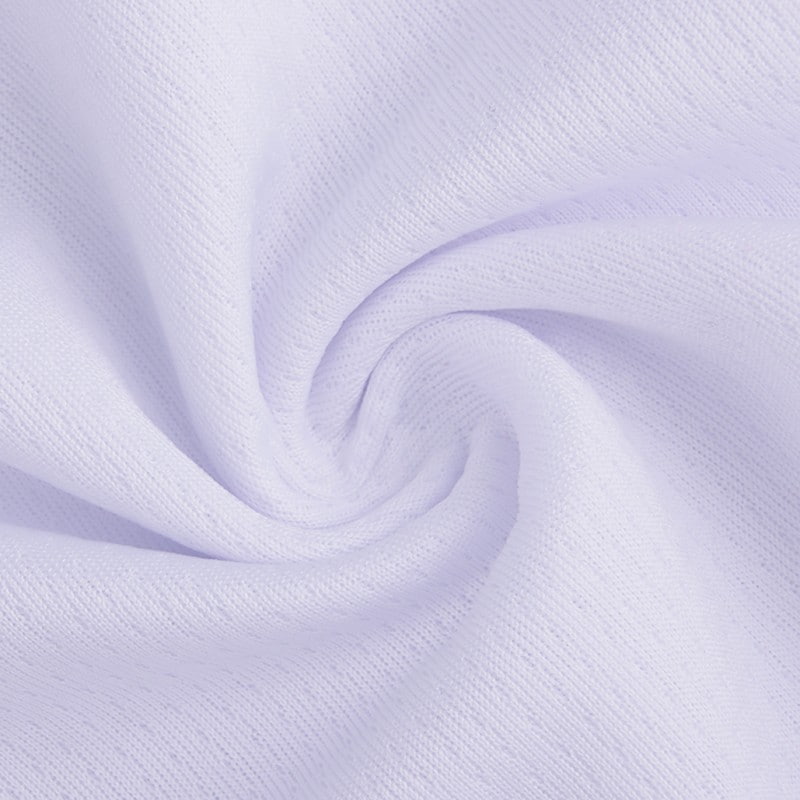
Interlock is a double knit: two faces knitted together with no distinct wrong side. It is the structure we reach for when a garment needs body rather than breathability. Our interlocks run from 140 grams, light and airy, up to 170 grams for an opaque, durable cloth with a firm texture that holds shape in leggings and fitted tops. Between those extremes sit piece-dyed versions, smooth-handle 165 gram cloths, and quick-dry cooling interlocks developed for activewear.
 Quick-Dry Cooling Polyester Interlock Fabric for ActivewearA 180 g/m², 183 cm wide polyester interlock with quick-dry cooling and stretch recovery, positioned for sportswear, gym wear, and athleisure.View Product →
Lining is the quiet workhorse of any performance range. Micro-dot knit uses a small textured dot on the reverse to reduce skin contact, which helps the fabric feel drier and lets four-way stretch work without restriction. Applications include garment linings, soft-touch next-to-skin layers and shoe uppers, where flexibility and moisture management matter more than surface appearance.
Weight is the fastest way to shorten a fabric list, but it should never be the only filter. The table below summarises how our four knit families typically behave.
| Knit family | Typical weight | Common width | Typical use |
|---|---|---|---|
| Bird's eye mesh | 145 - 150 gsm | 150 - 160 cm | Sportswear, jerseys, home textile lining |
| Grid and honeycomb | 115 - 165 gsm | 150 - 200 cm | Outdoor jackets, shoe uppers, sportswear linings |
| Interlock | 140 - 170 gsm | 160 cm | Activewear, fitted tops, leggings |
| Micro-dot knit | Light to mid | 150 - 160 cm | Linings, next-to-skin layers, shoe uppers |
Info. A heavier knit is not automatically a stronger one. Abrasion resistance depends more on yarn, stitch density and finishing than on grams per square metre.
Buyers who need to explain the choice to colleagues internally often find our overview of how designers, manufacturers and procurement teams choose the right fabric a useful starting point.
Knitting sets the structure; finishing sets the behaviour. Most of the performance claims on a garment tag come from what happens after the fabric leaves the machine.
Success. Test finish and structure together. A wicking treatment on an already fast-drying grid knit will outperform the same treatment on a dense interlock.
Most problems with polyester sports fabric do not come from the fibre. They come from a mismatch between what was specified and what was actually knitted.
Warning. Open mesh structures can snag during handling and transport. Ask for rolled, interleaved packing if the fabric will travel far before it is cut.
Polyester sports fabric is not a single product. It is a family of structures that happen to share a fibre. Separate them by knit type, weight and finish, and the specification process becomes far calmer, and the sample that arrives tends to be the one you expected.
We have been knitting these fabrics in Cixi since 2014, from a mill of roughly 36,000 square metres with more than 200 circular knitting machines and capacity of about 15,000 tonnes a year, exporting to over 20 countries. If you would like to know how we work, you can read more about our mill and our team. Otherwise, simply send us a brief: activity, expected weight, width, finish and target market are enough for us to come back with a starting recommendation.
Please check. Fibre labelling and import documentation rules differ by market. Confirm them before bulk production rather than after shipment.
Polyester mesh fabric has grown from a functional specialty material into one of the most widely used textiles in modern apparel and technical production. Its...
READ MOREA Derun Editorial — Fabric Engineering 100% Polyester Fabric: A Study in Structure It shapes a running shoe’s upper, lines a structured jacket, and lifts a go...
READ MORETechnical Fabric Series — Knitted Mesh The Quiet Intelligence of Bird Eye Knit A practical field guide to 100% polyester knitted bird eye fabric — the open-st...
READ MOREMay 27, 2026 – Global — The polyester mesh fabric industry is witnessing robust global growth in 2026, fueled by surging demand across sportswear, industrial m...
READ MORE Ready To Customise
100% Polyester Knitted Bird Eye Fabric: A Technical Guide to Breathable Knits
100% Polyester Fabric Explained: A Manufacturer's Guide to Performance Knits

Telephone: +86-18268669232

Email: [email protected]

Company Address
Linxi Village, Xiaolin Town, Cixi City

 English
 عربى
 中文