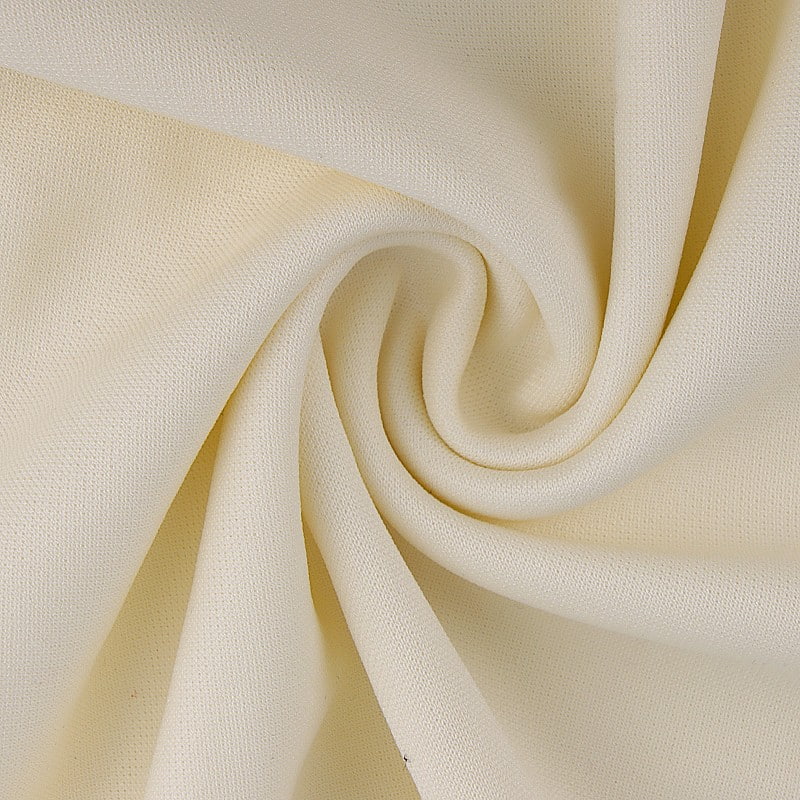
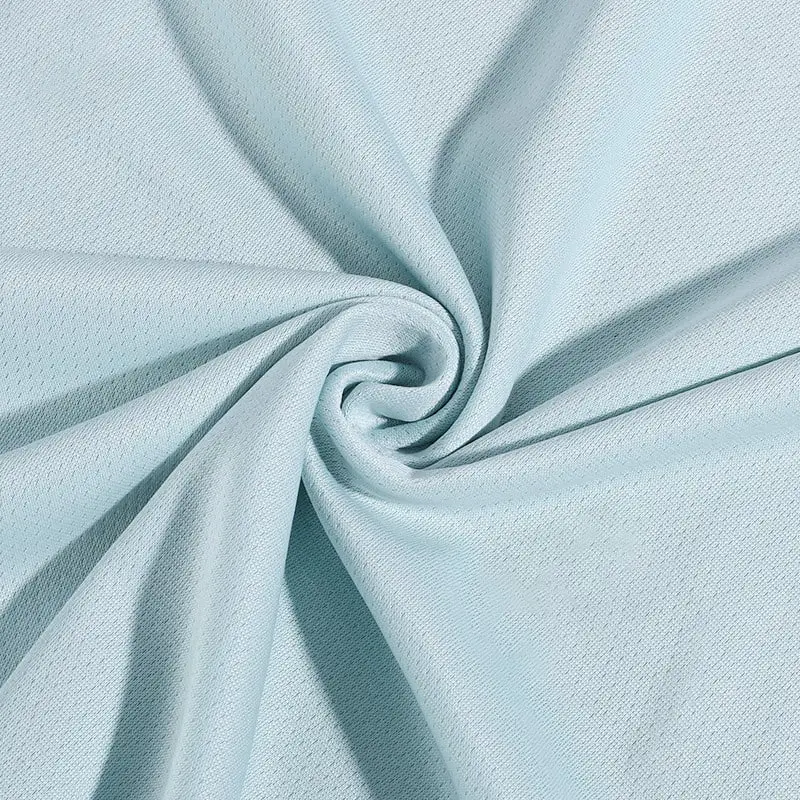
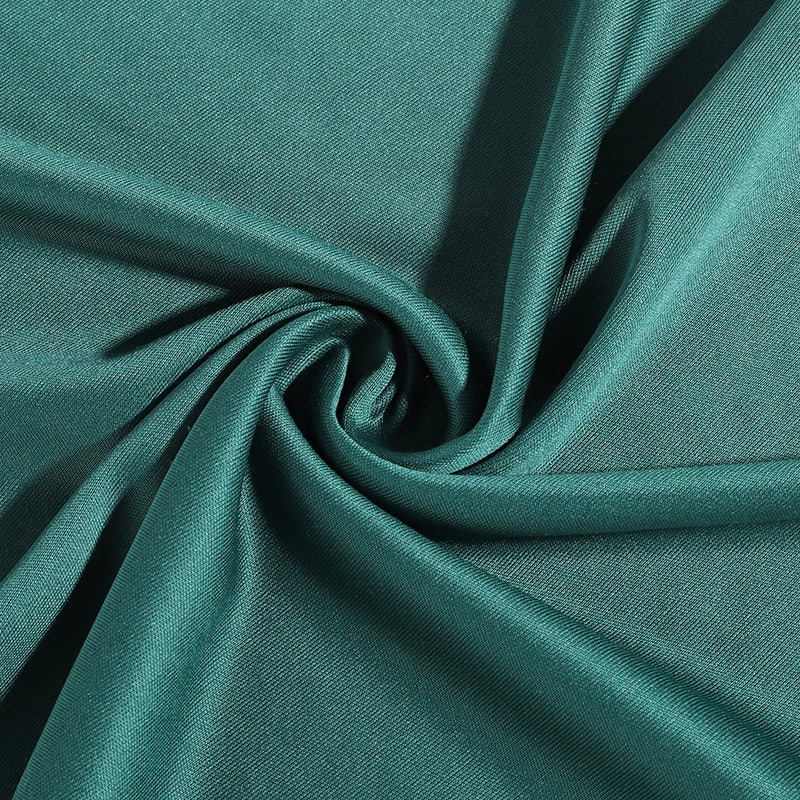
Every polyester knit is a geometry lesson: the way loops interlock, the way air moves through capillary channels, the way moisture is carried to the surface and released. The fiber is a constant; the structure is the variable.
Technical notes, Cixi Derun knitting floor
At its starting point, polyester is polyethylene terephthalate — a polymer family we know from transparent bottles and, today, from high-performance textile filament. Manufacturers melt the polymer, spin it into continuous filaments, and then texturize or draw those filaments to shape their character. When a finished fabric is labeled 100% polyester, the meaning is direct: the yarn is pure. No cotton, no wool, no elastane, no hidden content.
That purity is an advantage, not a concession. Because the filament is manufactured, it can be engineered with uncommon control — tri-lobal cross-sections for a dry touch, micro-denier filaments for softness, texturized yarns for bulk without weight. Dispersion dyes bond directly with polyester, producing color that stands up to washing and sunlight. A label that says 100% polyester is only the beginning of the story; yarn geometry and loop architecture are what turn a material into a garment you actually want to wear.
The same polyester yarn can become radically different fabrics, and the fork in the road is the machine. A woven fabric locks yarns at right angles, delivering crisp structure but limited stretch. A knitted fabric interlocks loops that move with the body, opening and closing as the wearer breathes, reaches, and recovers.
Circular knitting is the craft our mill has refined for nearly two decades. With more than two hundred high-precision circular knitting machines on the floor, we control needle gauge, cylinder diameter, and yarn feed so that one 100% polyester yarn can express itself as open mesh, dense interlock, or something in between.
Most performance programs come down to a small set of polyester knit architectures. Once a designer understands their character, choosing a fabric becomes a matter of matching structure to purpose rather than hoping a sample will work.
| Structure | Distinctive Character | Weight Range | Where You’ll Find It |
|---|---|---|---|
| Bird’s Eye Mesh | Open loops, strong wicking, quick drying | 140-150 gsm | Sportswear, home textile lining, safety garments |
| Interlock | Double-faced, opaque, stable yet supple | 140-170 gsm | Activewear, structured jackets, layering pieces |
| Micro-Dot Knit | Fine texture, four-way stretch, soft hand | ~145 gsm | Lining, shoe uppers, next-to-skin layers |
| Grid / Hexagonal Mesh | Airy, stable, textured surface | 115-165 gsm | Sports apparel, shoe upper, outdoor shells |
The same fiber, in other words, can feel breezy like a stadium seat or solid like a shell layer. Structure is the first decision; grams per square meter refine it; finishing tunes the rest.
For a deeper look at how mesh structures vary, our technical guide to polyester mesh fabric walks through each architecture in practical terms.
In performance wear, a fabric’s value lives in measurable details: how quickly it moves moisture, how much air passes through its loops, how well it recovers after stretch. None of these qualities can be pasted on afterward. They are engineered at three moments:
One of our most requested bird’s eye constructions for training kits balances an open hand with rapid wicking, so an athlete stays drier through repeated sprints.
 Lightweight Bird Eye Knit Fabric for SportswearThis polyester bird eye fabric offers an open structure and rapid wicking, ideal for training kits where athletes need to stay dry during repeated sprints.View Product →
For garments that need more substance — track jackets, hooded layers, structured tops — the quick-dry cooling interlock gives a double-faced smoothness while still releasing heat.
 Quick-Dry Interlock Fabric for ActivewearThis quick-dry interlock adds smoothness and substance to structured garments like jackets and hooded layers while releasing heat, making it a versatile performance choice.View Product →
And once the structure is right, the performance list is genuinely long:
Polyester carries a legitimate environmental tension. Its origin is petroleum; it does not decompose quickly; fine particles can shed in the wash. Those facts deserve respect. So does durability that keeps garments in rotation longer. A shirt that survives three years of weekly wear has a smaller footprint than a so-called natural shirt that loses its shape after three months — the difference is usually construction, not fiber.
A caution about cheap knits Thinly built meshes pill, stretch out, and trap heat against the skin. When a garment ends up in landfill after a handful of uses, the waste is real regardless of the fiber printed on its label.
A caution about greenwashing Vague promises of eco-friendly or biodegradable polyester, without certification or recycling infrastructure, are marketing language. Genuine progress happens in bottle-to-fiber and garment-to-garment initiatives that can actually be traced.
Reliability as a strategy A stable 100% polyester knit that keeps its shape and color through dozens of wash cycles reduces the need for replacements. In an industry of overproduction, that resilience is quietly valuable.
Caring for a long-lived knit Wash at 30 degrees, skip fabric softener — it coats the filaments and slows wicking — and air dry or tumble on low. The energy is invested at production; the lifespan is written in daily habits.
For a brand or a garment factory, 100% polyester fabric is usually the quiet foundation of a product. Foundations are tested by consistency: weight within tolerance, dye lots matched, edges clean, hand feel identical roll after roll.
That level of discipline is why Cixi Derun has grown into a leading polyester knit mill. Our 36,000 square meter plant in Cixi, on the southern shore of Hangzhou Bay, runs more than 200 round-knitting machines and 18 high-speed elastic yarn machines to produce around 15,000 tonnes of fabric each year, with a second-phase facility lifting capacity toward 20,000 tonnes.
For footwear and lining programs, our micro-dot shoe-upper knit is a useful example of purpose-built engineering: four-way stretch, a clean smooth surface, and dimensional stability that holds lasting lines.
 Micro-Dot Shoe Upper Knit FabricFor footwear and lining programs, this micro-dot knit provides four-way stretch, a clean surface, and enhanced tear resistance, supporting lasting shoe structure.View Product →
Our company story and production philosophy are documented on our about page, for anyone who wants to look behind the mill gates.
100% polyester fabric deserves better than the shorthand of a label. It is a canvas for structure: loop by loop, a fabric can be designed to breathe, to stretch, to protect, and to last. The next time you pick up a lightweight training tee or a structured track jacket, look again — the material is the message, and the structure is the story.
Technical Fabric Series — Knitted Mesh The Quiet Intelligence of Bird Eye Knit A practical field guide to 100% polyester knitted bird eye fabric — the open-st...
READ MOREPolyester mesh fabric has grown from a functional specialty material into one of the most widely used textiles in modern apparel and technical production. Its...
READ MOREMill Notes - Performance Knits Polyester Sports Fabric A working guide to knit structures, weights and finishes, written from the knitting floor rather than th...
READ MOREFrom Yarn to Finished Fabric: The Polyester Interlock Manufacturing Journey There is a quiet complexity in every yard of polyester interlock fabric. It feels s...
READ MORE Ready To Customise
100% Polyester Knitted Bird Eye Fabric: A Technical Guide to Breathable Knits
100% Polyester Fabric Explained: A Manufacturer's Guide to Performance Knits

Telephone: +86-18268669232

Email: [email protected]

Company Address
Linxi Village, Xiaolin Town, Cixi City

 English
 عربى
 中文